
HIS EMS · HIS ENERGYFLOW
Energy management system for business and industry
HIS EMS coordinates battery storage, solar PV, EV charging and flexible loads as one energy system. Manage demand peaks, use solar energy effectively and connect dynamic tariffs and energy-trading interfaces.
Request a project-specific EMS demonstrationDeveloped in Germany. Integrated and supported by HIS.
HIS EMS combines local energy control with the HIS EnergyFlow portal. HIS coordinates battery storage, power conversion, PV and charging infrastructure around your operating objectives and supports integration, commissioning and operation. You receive a coordinated system with defined interfaces and HIS as your point of contact.
What can HIS EMS do for your site?
An EMS coordinates generation, consumption and storage using measurements, forecasts and operating objectives. HIS configures the functions for your project.
| Function | Benefit and implementation |
|---|---|
| Peak shaving | Physical import-power control and interval-based peak management: use the battery to manage grid demand, including Germany’s 15-minute demand average. |
| PV self-consumption and forecasts | Store solar surplus and plan charging around site-specific weather and generation forecasts, leaving capacity available for expected solar peaks. |
| Dynamic electricity tariffs | Price-based strategies for storage and flexible loads. Available price data, the supply tariff and additional electricity costs are considered for each project. |
| Intelligent charging infrastructure | Allocate charging current between compatible charging points, set priorities and time windows, and incorporate solar surplus and battery storage. |
| Sector coupling | Integrate compatible heat pumps, immersion heaters and other controllable loads into the site strategy. |
| Export limits and grid instructions | Implement PV curtailment, zero-export control and external instructions within the agreed control architecture, alongside the required protection and plant controls. |
| Multi-use and operating priorities | Link strategies using state of charge, time and other conditions. Reserves and priorities determine which application can use the battery. |
These capabilities are available within the HIS EMS offering. Their implementation depends on hardware, firmware, interfaces, licences and the agreed configuration.
Make the operating strategy visible
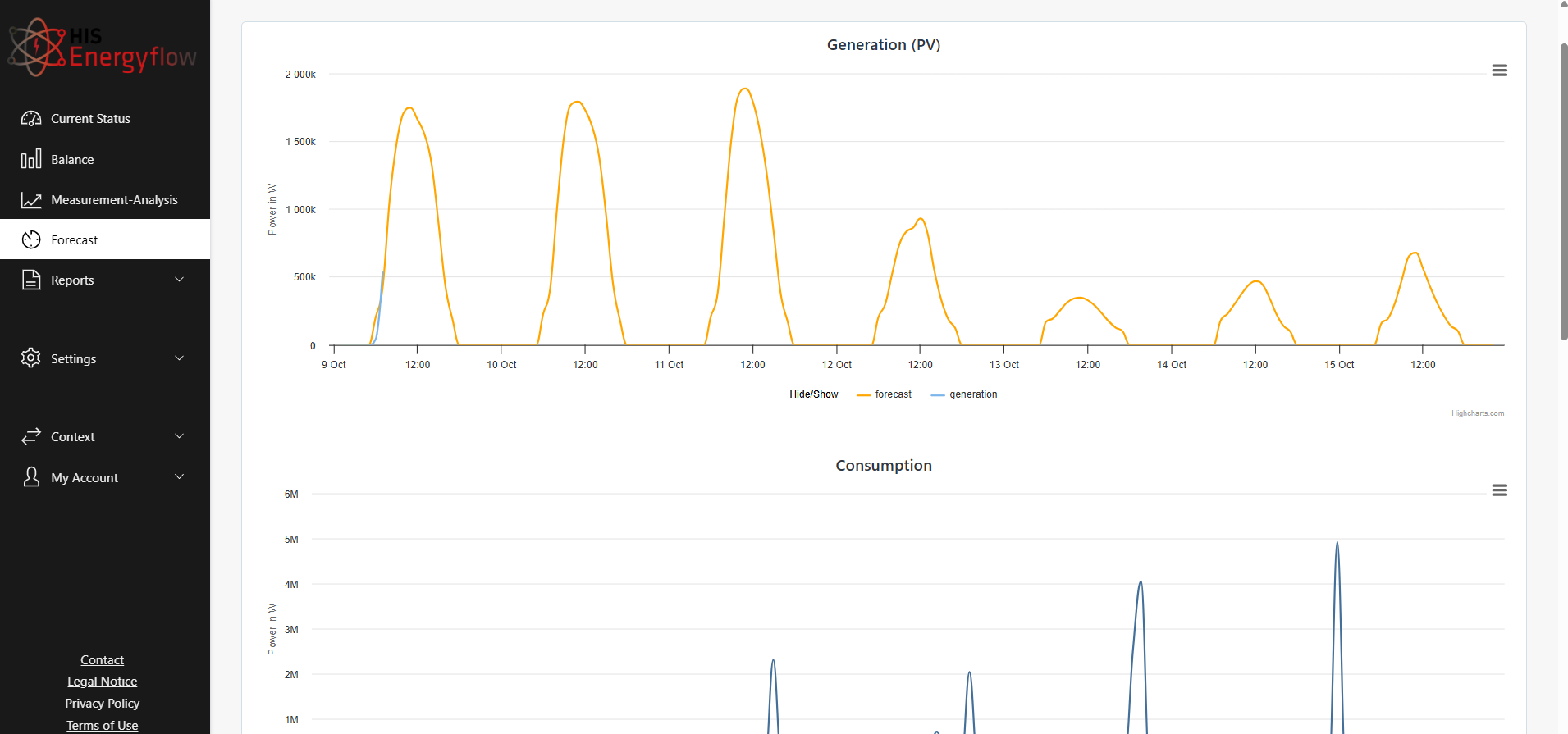
HIS Energy Manager provides local control and communication. The HIS EnergyFlow portal makes energy flows, operating data and configurable settings accessible for the relevant user roles. We define compatible devices, metering, permissions and the functions included in your project.
HIS EnergyFlow: understand energy flows and review operation
- Live energy flows, device status and system topology in one place.
- Historical trends and data exports for analysis.
- Separate access for operators, technicians and administrators.
- Manage multiple systems with remote access subject to authorised permissions.
Open integration, checked against your equipment
HIS connects compatible meters, PV and battery inverters, BMS, charging points and heat pumps. Model, firmware, available measurements and supported control functions determine compatibility. Send your equipment list and single-line diagram for an interface review.
From battery flexibility to market participation
Start with the site objective. Then agree how much power and energy can be offered to a trading partner without conflicting with the site’s operating priorities.
The trading interface can receive battery charging, export and PV-curtailment setpoints. Feedback such as state of charge, battery power, PV power and grid power supports coordination with the trading partner.
Optimise the site
Peak shaving, PV self-consumption, time-of-use operation and EV charging support. Applications and priorities depend on the installed equipment and agreed configuration.
Day-ahead and intraday
A trading partner provides market access and trading schedules or setpoints. HIS defines the technical interface, metering and operating limits with the partner.
Balancing services
FCR, aFRR and mFRR can be assessed with an appropriate partner. Participation depends on the country, technical eligibility, prequalification and the commercial agreement.
Clear responsibilities, from market signal to battery
Trading partner
Market access, bidding, trading strategy and settlement under the agreed contract.
HIS EMS and system integration
Interface coordination, site priorities, setpoint handling and monitoring within the agreed system architecture.
PCS, BMS and grid controls
Power conversion, battery protection and the applicable grid-control functions. An EMS does not replace required protection or a project-specific plant controller.
What we check before trading starts
- Import/export limits, connection voltage and the metering concept.
- Available kW and usable kWh, state-of-charge reserve, efficiency and auxiliary consumption.
- Battery cycling, degradation and warranty conditions for the intended use.
- Partner protocol, telemetry, command timing and behaviour if communication is lost.
- Market eligibility, commercial fees and the division of responsibilities.
A credible business case separates site savings from potential market revenue, and includes losses, fees and battery use. Results depend on prices, availability and the agreed operating strategy; revenue is not guaranteed.
Real projects, practical discussion
Nice supermarket: 1,165 kWh / 460 kW for energy trading and EV charger power boosting. Bulgaria: 3,260 kWh / 1,370 kW for energy trading. These references demonstrate project applications and scale, not a promised return for another site.
Explore the reference projectsFrom project assessment to operation
1 · Assess and size
Review site data, applications, connection requirements and the technical and commercial assumptions.
2 · Define and integrate
Agree battery, PCS, EMS, interfaces and the scope of supply with the installer or EPC.
3 · Commission and support
Commission the agreed system, review operating data and define the ongoing support scope.
Installation and civil works are performed by the appointed installer/EPC unless expressly included in the HIS offer. The project offer defines responsibilities, commissioning and service scope.
See project delivery and responsibilitiesEnergy management system: frequently asked questions
What is the difference between an EMS, BMS and plant controller?
The EMS coordinates site energy flows and operating strategies. The BMS monitors and protects the battery. The plant controller performs the functions required by the grid-connection design. HIS coordinates these control layers.
Can HIS EMS use dynamic electricity tariffs?
Yes. Price-based strategies can adapt consumption and charging times to available electricity prices. A dynamic supply tariff is distinct from selling battery flexibility through a trading partner.
Can existing solar systems and charging points be integrated?
Many devices can be integrated. HIS checks the specific model, firmware, metering arrangement and required functions before confirming compatibility.
Does an EMS automatically provide backup power?
Backup strategies also require suitable battery and inverter equipment plus the appropriate switching and protection design. EMS functionality alone does not make a battery system backup-capable.
Can I combine trading with peak shaving or EV charging?
Potentially, yes. Available power and energy must be allocated between applications. We review priorities, reserves and trading restrictions so the same capacity is not counted twice.
Can HIS work with my trading partner?
We review the proposed partner’s interface and technical requirements. Compatibility, integration effort and supported markets are confirmed for the project.
Are all available functions included in every offer?
HIS can offer the EMS platform’s functions for your project. The offer defines the actual scope, required licences, compatible devices and services.
Request a project-specific EMS demonstration
HIS supports system design, grid integration, commissioning and ongoing operation, working with your installer or EPC.
Request a BESS project assessment

