
HIS ENERGY · AGRI-PV · BESS
Battery storage for agrivoltaic solar parks
Plan grid integration and electricity marketing together. Containerised battery storage, 800 V integration and German-developed energy management for developers, EPCs and operators.
Request an agrivoltaic BESS assessmentExplore container configurations
Agrivoltaics combines farming and solar generation on the same land. Battery storage adds flexibility over time: it can hold solar electricity for later sales, absorb generation peaks within its technical limits and, with an appropriate connection and metering arrangement, also charge from the grid.
For developers, EPCs and operators focused on grid export. Whether your PV project is 1–4 MWp or a different size, battery capacity follows the generation profile and business model rather than a fixed MWp-to-MWh ratio.
What should your agrivoltaic battery achieve?
Work within export limits
Store PV generation above the available export capacity for later sales. HIS matches charging power and capacity to your generation profile, approved connection limits and available discharge windows.
Improve solar marketing flexibility
Shift electricity from unattractive production periods to other sales windows. Negative-price exposure depends on the actual contract and support arrangement. Assess additional value after losses, fees and degradation.
Combine solar and grid charging
Additional charging windows from the grid can support a market-based strategy. This requires permitted import capacity, appropriate metering and settlement, and coordination with the trading partner and network operator.
Solar-only storage or combined solar and grid charging?
| Operating model | Charging source | Clarify before sizing |
|---|---|---|
| PV-led storage | Electricity from the associated PV plant | Generation profile, support/marketing arrangement, export windows and restrictions |
| Mixed-source storage | PV electricity and grid imports | Also import approval, energy allocation, metering concept and trading strategy |
The German terms “Grünstromspeicher” and “Graustromspeicher” describe charging and accounting arrangements, not different battery technologies. Approval to export PV electricity does not automatically authorise grid charging.
Germany · reviewed 20 October 2026: The MiSpeL determination enables proportional support and levy privileges for mixed-source storage under specified conditions. Early use of the new options through September 2027 requires agreement from the network and metering operators. The applicable arrangement must be coordinated with the project’s market partners. Bundesnetzagentur information on MiSpeL. Projects outside Germany require assessment under local rules.
Assess the economics before fixing battery size
For projects with low self-consumption, flexible solar electricity sales become a priority. A project-specific economic assessment examines the additional value storage could create compared with operation without a battery, using your generation profile, contract and grid connection.
1. Understand the data
Combine quarter-hourly generation, export and consumption data with connection limits, commissioning date and electricity marketing or support contracts.
2. Compare alternatives
Compare no storage, a smaller system and the requested configuration. A target such as 1 MW / 2 MWh at 800 V must be tested against operating windows and available product configurations.
3. Evaluate the result
Include investment, losses and auxiliary consumption, degradation, availability, service and marketing fees. Assess cash flow, net present value and payback in base and conservative scenarios.
Sound sizing considers the generation profile over time and the actual commercial terms, including contract prices, applicable support and achievable revenues. We agree the scope and data requirements of a detailed techno-economic study with you. Start the conversation with the project information you already have.
800 V containers: one system or several units
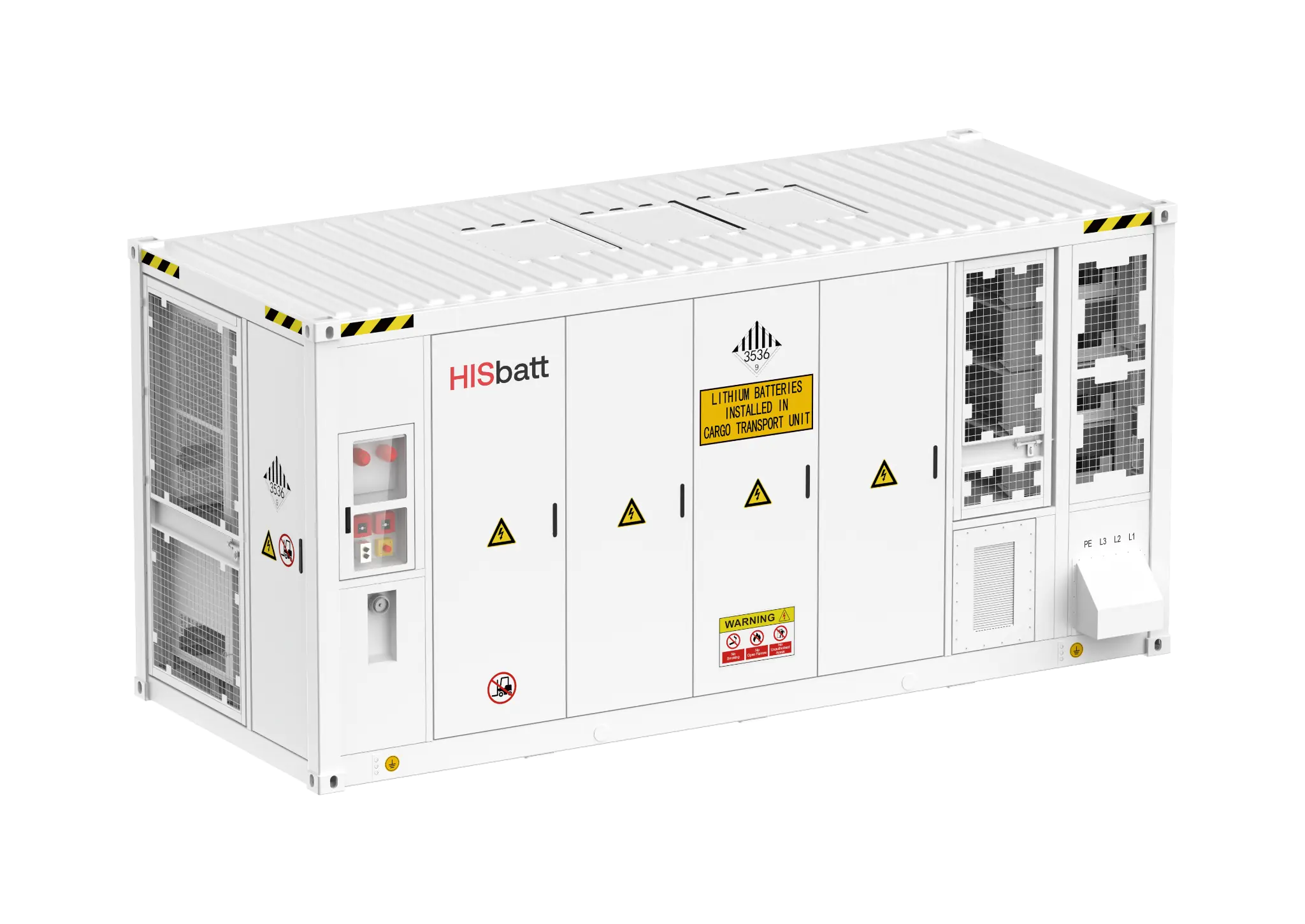
The HISbatt PowerPack combines LFP batteries, integrated PCS and energy management. Its 800 V AC interface suits appropriately designed busbars and transformer connections. HIS matches the voltage architecture to your grid connection and plant design.
| Containers | Installed energy | Total PCS apparent power |
|---|---|---|
| 1 | 3.344 MWh | 1.6 MVA |
| 2 | 6.688 MWh | 3.2 MVA |
| 3 | 10.032 MWh | 4.8 MVA |
These examples illustrate potential project sizes. HIS sizes the configuration for your site; smaller PowerPack configurations are also available subject to project assessment. Installed energy is not usable AC energy delivered at the grid connection. MVA denotes apparent power; active power, reactive-power requirements, losses and connection limits require separate assessment.
German-developed EMS with clear technical interfaces
HIS energy management coordinates operating strategies and monitors generation, battery state and energy flows. Charging and discharge schedules, power limits and interfaces to the electricity marketing partner are defined for the project.
- EMS: operational optimisation, data visualisation and agreed schedules.
- Plant controller, protection and metering: implementation of network-operator requirements within the plant design.
- Trading partner / optimiser: market access, electricity marketing and settlement within the agreed scope.
HIS matches equipment, interfaces and required licences to your operating strategy. For balancing services, we review technical and commercial requirements with the trading partner, including prequalification where applicable. Potential revenues are assessed using project-specific assumptions.
HIS supports system selection, integration, commissioning and agreed support. Civil works and electrical installation are provided by the responsible EPC or installation partner unless expressly included otherwise in the offer.
Custom colours for your site
Your battery container can be supplied in an agreed RAL colour, such as green to blend into its agricultural surroundings. We agree the finish with you to suit your project.
Site planning and integration
Good site planning supports installation, safe operation and maintenance. Coordinate access and crane space, foundations, service clearances, fire-service access, drainage and noise requirements with your planning partner. HIS supports coordination of the technical system interfaces.
Technical details and proven BESS experience
Explore HISbatt PowerPack 800V specifications and completed HIS storage projects across different applications. See our systems and integration experience in practice.
Explore PowerPack 800VDownload datasheet · German
HIS energy management · BESS reference projects · All downloads
Frequently asked questions about agrivoltaic battery storage
When does battery storage make sense for agrivoltaics?
Battery storage can make sense when time-shifted electricity sales, reduced generation curtailment or other permitted operating models justify investment and operating costs. HIS assesses PV generation, grid access and electricity marketing together to identify a suitable solution for your project.
How should an agrivoltaic battery be sized?
The appropriate size follows the generation profile, charging and discharge power, usable capacity, connection limits and operating model. HIS compares suitable configurations using your project data. A target such as 1 MW / 2 MWh can serve as a starting point for assessment.
Can the battery charge from both solar and the grid?
A suitable bidirectional system can technically use both sources. Operation requires an agreed connection, metering and marketing arrangement. Permission to export PV electricity does not automatically authorise grid imports for battery charging.
How can storage help with negative electricity prices?
Storage can shift solar electricity from unattractive price periods into later sales windows. The operating strategy accounts for available capacity, charging power and contract or support arrangements. Economic value is assessed against later revenues, storage losses and operating costs.
When is an 800 V battery solution suitable?
800 V AC is an integration option for appropriately designed busbars and transformer connections. HIS assesses the voltage architecture alongside your solar park and grid-connection requirements. It is not a universal requirement for agrivoltaics.
Can several PowerPack containers be combined?
Several units can be combined subject to project engineering. Two 3.344 MWh units provide 6.688 MWh installed energy and, with 1.6 MVA per unit, 3.2 MVA aggregate PCS apparent power. Grid power, usable energy and expansion requirements must be assessed separately.
Can the container be supplied in green?
Yes. An agreed RAL colour is available on request, such as green to blend into agricultural surroundings. We agree the appropriate finish with you during project planning.
What information does HIS need initially?
Share what you already know: location, PV capacity, connection status, intended operating model and schedule. Generation profiles, import/export limits, layouts and single-line diagrams can follow later. You do not need a final battery size to enquire.
YOUR AGRIVOLTAIC PROJECT
Which storage solution fits your project?
Share what you already know. Our team reviews the technical approach and agrees the next steps with you. A final battery calculation is not required for an initial enquiry.
Useful optional details: PV capacity, location, connection status, export/import limits, solar-only or solar-plus-grid operation and schedule. Add a layout, single-line diagram or generation data through the enquiry form. Unknown details can be left open.
Request an agrivoltaic BESS assessment
Start with a short project enquiry. We then review the technical details together by email or, if you prefer, in a discussion.
Further background: Fraunhofer ISE · Agri-PV · Bundesnetzagentur · Grid connection. Content reviewed: 20 October 2026.


